Power Grid Strategy Guide · Updated June 2026

Best Power Grid Strategies for Crypto Mining in Vancouver

Electricity is the single largest recurring cost in any Vancouver crypto mining operation — and the operators who master the best power grid strategies for crypto mining in Vancouver hold a compounding economic advantage over those who do not. BC Hydro's rate structure rewards intelligent load management, proper tariff selection, and well-engineered service entrances with meaningfully lower bills every single month. This guide covers every lever available to Vancouver-area crypto miners: BC Hydro rate schedule optimization, demand charge reduction, power factor correction, load management infrastructure, grid connection strategy, and backup power design — so you can reduce your monthly electricity spend from the day your facility goes live.


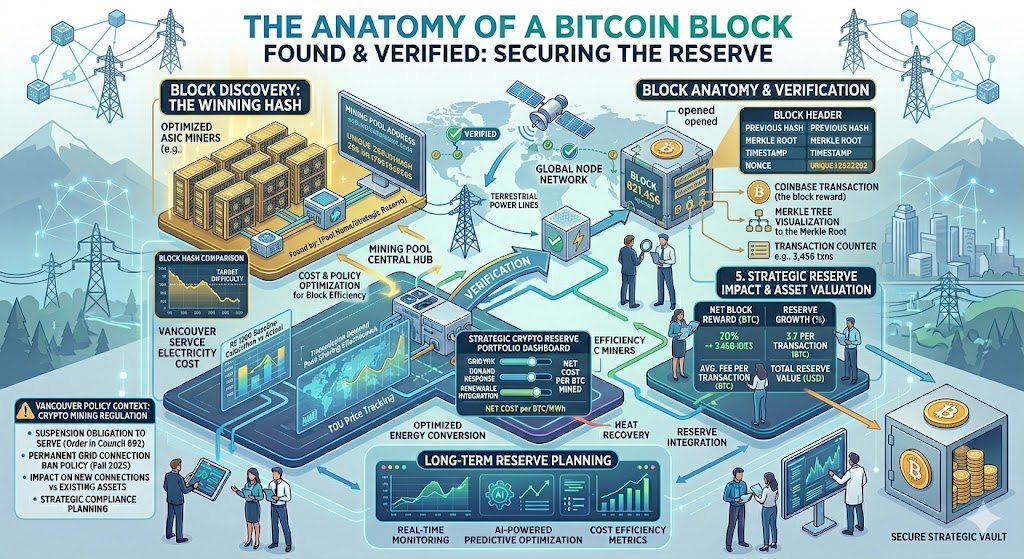
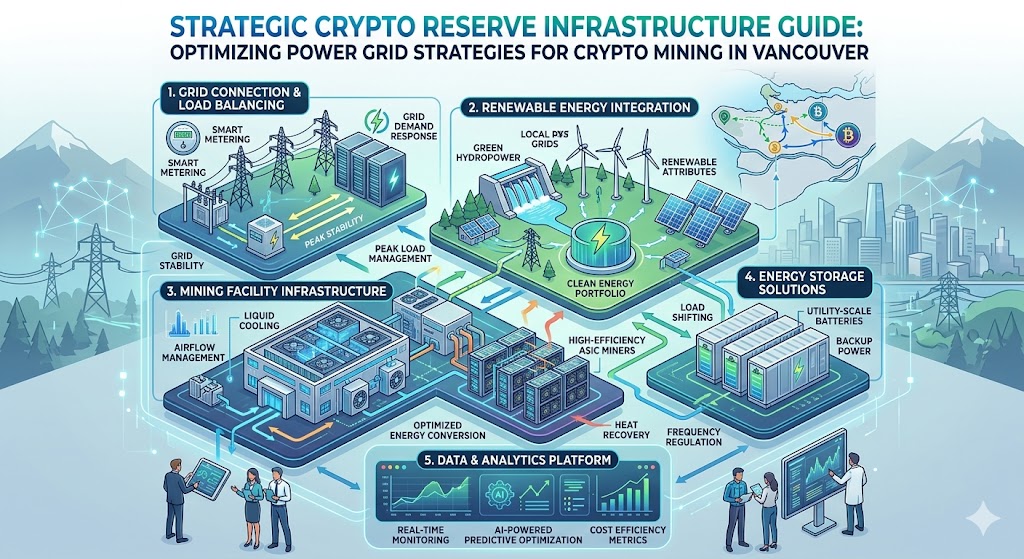
Best power grid strategies for crypto mining in Vancouver — Strategic Crypto Reserve infrastructure guide illustration

Power Strategy

BC Hydro · Vancouver

Why Power Grid Strategy Is the Most Important Cost Variable in Vancouver Crypto Mining

Of all the operational variables a crypto mining business in Vancouver can control, none has a greater impact on long-term profitability than power grid strategy. Hardware is a one-time capital expenditure. Electricity is a permanent obligation that recurs every single day. For a commercial-scale mining operation, electricity represents 55–70% of total monthly operating expenditure — which means that a 15% reduction in power costs is more valuable than almost any hardware upgrade or operational efficiency improvement you could make elsewhere.

Vancouver and the broader British Columbia grid present a genuinely unique environment for crypto mining operators. BC Hydro's hydroelectric generation base produces electricity at among the most competitive industrial rates in Canada — but only for operators who correctly navigate the utility's rate schedule structure, demand charge framework, and service application process. Operators who default to standard commercial rates, fail to qualify for industrial tariffs, or run poor-quality power infrastructure leave thousands of dollars per month in savings on the table — permanently.

The stakes are even higher when you consider that power grid decisions are not easily reversible. Your service entrance rating, transformer capacity, distribution panel sizing, and UPS infrastructure are built into the physical facility. Getting these decisions right before construction begins determines your operating cost floor for the entire life of the operation. This is why power grid strategy must be the first planning discipline, not an afterthought addressed after hardware is ordered and a facility lease is signed.

Strategic Crypto Reserve has operated blockchain infrastructure and a crypto data center in British Columbia through multiple market cycles, and the power grid lessons from that operational experience form the backbone of every recommendation in this guide.
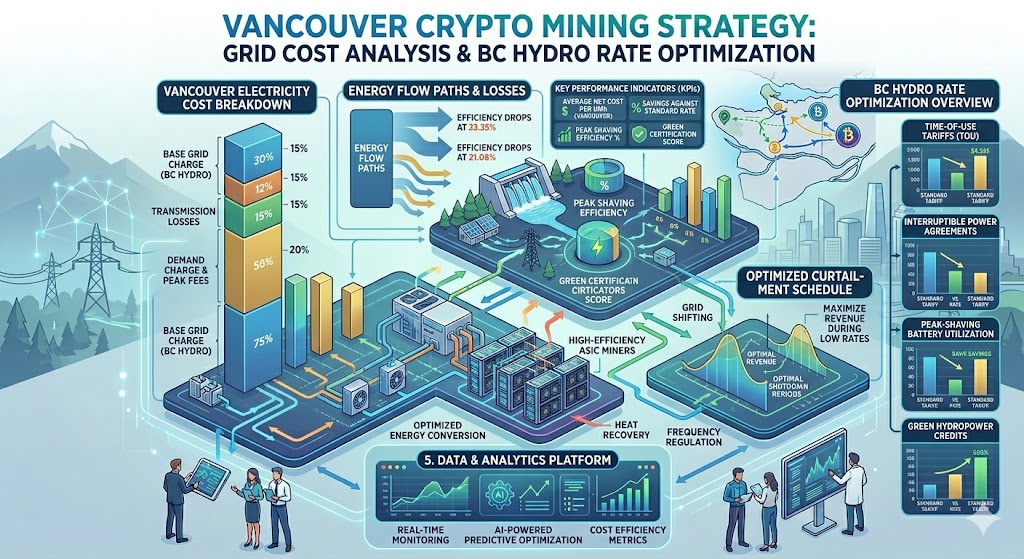
Power grid strategy importance for Vancouver crypto mining — electricity cost breakdown and BC Hydro rate optimization overview

BC Hydro Rate Schedules Explained for Vancouver Crypto Mining Operators

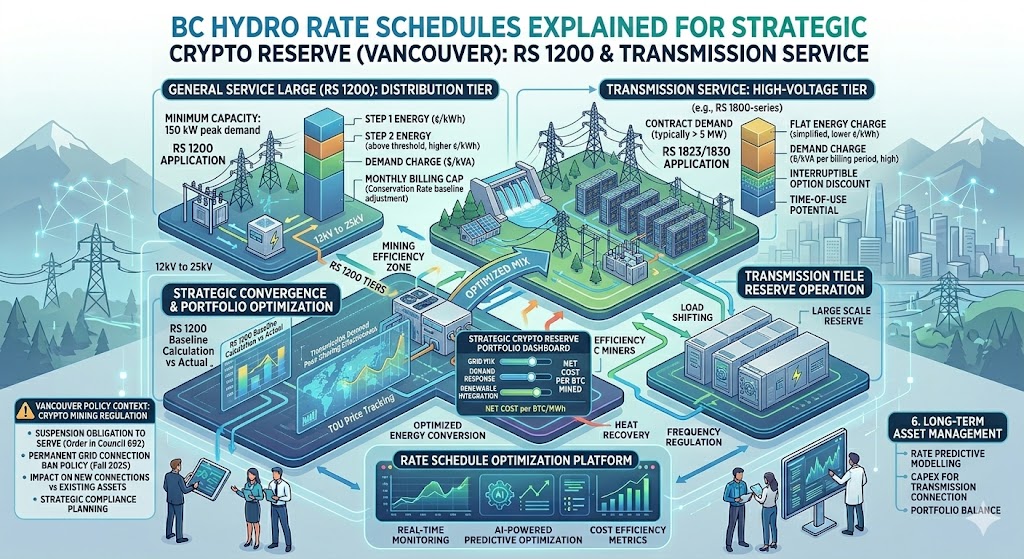
BC Hydro rate schedule explained for Vancouver crypto mining — General Service Large RS 1200 and Transmission Service rate tiers

BC Hydro's commercial rate structure is built around service classes that scale with a customer's peak demand. Understanding which rate schedule applies to your operation — and engineering your facility to remain within the most favourable applicable tariff — is the foundational power grid strategy for every Vancouver crypto mining operator.

Every rate schedule includes three billing components: a basic monthly charge (a flat administrative fee), an energy charge (cents per kilowatt-hour consumed), and a demand charge (dollars per kilowatt of peak 15-minute demand within the billing period). The demand charge component is the most important to understand — and the most powerful lever to optimize — because it is driven entirely by your worst single 15-minute period in a given month, not by your average consumption.

BC Hydro also applies a two-step (tiered) energy charge to most commercial rate classes. Consumption up to a defined monthly threshold is billed at the lower Step 1 rate; consumption above that threshold is billed at the higher Step 2 rate. For crypto mining facilities running hardware 24 hours a day, virtually all consumption falls into Step 2 — making the per-kilowatt-hour rate paid by a crypto miner on a standard commercial tariff materially higher than what an industrial-tariff-qualifying operator pays.

The following table compares the three most relevant BC Hydro service classes for Vancouver crypto mining operators:

BC Hydro Rate Schedule Demand Threshold Best For Key Billing Components Crypto Mining Suitability
RS 1100 — General Service Small Under 35 kW Very small operations: 5–7 ASIC miners max Basic charge + two-step energy rate (no demand charge) Low — outgrown by any serious operation
RS 1200 — General Service Large 35 kW to ~999 kW Medium-scale facilities: 10–200 ASIC units Basic charge + demand charge ($/kW) + two-step energy rate High — most common rate for commercial miners
RS 1600 — Transmission Service Over 1,000 kW Large commercial facilities: 200+ ASIC units Basic charge + demand charge + energy rate + transmission component High — purpose-built for industrial-scale mining
Industrial Rate (Qualifying) Varies by application Large BC operations meeting industrial criteria Negotiated rate with BC Hydro; typically lowest blended cost per kWh Best possible — requires formal qualification

Step 2 Trap: The most costly mistake made by new Vancouver crypto mining operators is running a 24/7 operation on a rate schedule designed for businesses with variable, daytime-only power consumption. On a standard RS 1200 account without industrial tariff qualification, a crypto mining facility consuming 500,000 kWh per month pays the Step 2 rate on the majority of that consumption. Qualifying for the appropriate industrial service class can reduce the effective blended rate by 20–35% — a difference that compounds into hundreds of thousands of dollars in savings over the lifetime of a commercial mining operation. Consult with BC Hydro's commercial services team and engage an electrical engineer familiar with BC utility regulations to confirm which rate class and tariff tier your specific operation qualifies for.

The Six Best Power Grid Strategies for Crypto Mining in Vancouver

The following six strategies represent the most impactful and proven approaches for reducing power costs and improving grid reliability for crypto mining operations in Vancouver and Greater BC. They are ordered by the sequence in which they must be addressed — each depends on the prior one being in place. Operators who implement all six strategies gain a cumulative power cost advantage that compounds with every billing cycle.

  1. Model Total Facility Demand and BC Hydro Tariff Eligibility First: Before signing a facility lease or ordering a single ASIC miner, calculate your total connected hardware load in kilowatts. Add your estimated cooling, networking, and facility overhead (typically 30–45% of computing load). Confirm which BC Hydro rate schedule this total places you in and whether you qualify for industrial tariff pricing. This single analysis determines your entire ongoing operating cost structure. Hardware decisions made before this analysis is complete are made without knowing the true cost of running that hardware.
  2. Submit Your BC Hydro Service Application Before Any Other Commitment: The BC Hydro commercial service application — not the facility lease, not the hardware order — is the first physical action in your project. Service entrance upgrades for large commercial loads in the Vancouver area take four to twelve months from application to energized switchgear. Submitting the application on day one of your planning process keeps your hardware delivery and your power availability synchronized. Submitting it after signing a lease and placing a hardware order is the single most common and most expensive planning error in the Vancouver crypto mining space.
  3. Engineer Your Service Entrance for Demand Peak Minimization: Work with a licensed electrical engineer to design your distribution infrastructure specifically to minimize your peak 15-minute demand reading each billing period. The critical design elements are: phased hardware startup sequencing to spread inrush current across time rather than concentrating it at a single moment; smart PDU zone segmentation that allows you to selectively curtail specific rack zones during grid stress events; and sub-metering at each distribution panel so you can identify exactly which hardware cluster drives your demand ceiling. Shaving even 10–15% off your peak demand reading reduces your demand charge by the same percentage — every month, permanently.
  4. Deploy Smart PDU Infrastructure for Real-Time Load Management: Install smart Power Distribution Units with per-outlet current and wattage monitoring at every rack position in your facility. Connect all PDUs to a centralized dashboard displaying real-time total facility draw, zone-by-zone consumption, and per-unit power readings. Configure automated alerts triggered when total facility draw approaches your demand target threshold. This infrastructure is what makes demand response and curtailment possible in practice — without it, you are flying blind on your most important cost variable. For guidance on the specific hardware and configuration required, our complete guide to building a small-scale crypto data center covers smart PDU selection and configuration in detail.
  5. Install Power Factor Correction to Eliminate Reactive Demand Penalties: BC Hydro applies a power factor adjustment charge to commercial accounts where the measured power factor falls below 0.90. Power factor represents the efficiency with which your facility converts drawn power into useful work — a factor below 0.90 means you are consuming reactive power that BC Hydro must supply but cannot bill you for at its full cost, triggering a penalty charge on your account. Install a capacitor bank at the main distribution panel sized to bring your facility-level power factor above 0.95. Modern ASIC miners typically achieve power factors of 0.95–0.99 natively, but mixed hardware environments, long cable runs, and older PSU units can degrade facility-level power factor below the BC Hydro threshold. Measurement before installation is essential — engage a licensed electrical contractor with a power quality analyser before specifying a capacitor bank size.
  6. Build Grid Redundancy to Protect Mining Revenue Against Outages: Connect your management infrastructure to a UPS for clean ride-through during brief grid events. Install a diesel or natural gas generator with an Automatic Transfer Switch for extended outage protection. The generator payback calculation for a Vancouver crypto mining operation is straightforward: multiply your average hourly mining revenue by the number of hours your facility would be down during a typical annual outage event, then compare that to generator capital and annual maintenance costs. For operations generating meaningful daily mining revenue, the economics of backup power infrastructure are unambiguous.
Six best power grid strategies for crypto mining in Vancouver — step-by-step power optimization guide for BC Hydro commercial mining operations

Demand Charges: The Most Misunderstood Line Item on a Vancouver Mining Electricity Bill

Demand charge reduction strategies for Vancouver crypto mining — peak load management, smart PDU monitoring, and BC Hydro RS 1200 demand billing explained

The demand charge component of BC Hydro's Rate Schedule 1200 is one of the most impactful and least understood billing elements for Vancouver crypto mining operators. Unlike the energy charge — which accumulates proportionally with every kilowatt-hour consumed — the demand charge is triggered by a single worst-case 15-minute window in the entire billing period. Once that peak is set, you pay the demand charge for the full month regardless of whether that peak was a one-time event or your continuous baseline.

For crypto mining facilities running ASIC hardware 24 hours a day, the demand charge effectively locks in at or near your total installed hardware load from the first day of each billing period. This creates a structural incentive to manage your peak carefully — particularly during hardware deployment phases, maintenance windows, and any event where multiple units restart simultaneously after a power cycle.

The most effective demand charge reduction tactics for Vancouver crypto mining operations are:

  1. Phase Hardware Deployment Across Billing Periods: Rather than powering on all hardware in a single week, stagger deployment across multiple billing months. Each new batch of ASIC miners added to a facility establishes a higher demand ceiling for that billing period. By deploying in batches and allowing each group to reach thermal and electrical steady-state before the next batch is added, you avoid the demand charge spike that comes from a mass simultaneous startup.
  2. Participate in BC Hydro's Industrial Conservation Initiative (ICI): BC Hydro's ICI program provides billing credits to qualifying large commercial and industrial customers who voluntarily reduce their load during BC Hydro system peak periods — typically weekday afternoon hours during cold-weather months. Crypto mining operations are well-suited for ICI participation because ASIC miners can be curtailed and restarted cleanly without process disruption, and the revenue impact of short curtailment windows is quantifiable and predictable. Enrolment in the ICI program creates a formal channel for demand response credit that directly offsets your monthly billing.
  3. Schedule Planned Maintenance During the Same Billing Period: Each mass power cycle — whether for firmware updates, PSU replacement, or scheduled maintenance — creates a simultaneous inrush current event that can spike your demand reading. Concentrate all planned maintenance, firmware cycles, and hardware restarts into a single week or billing period rather than distributing them across the year. This limits the number of demand spike events and ensures that the few high-demand moments in your operational calendar happen within the same billing cycle that already has the peak established.
  4. Use Smart PDU Load Shedding for Precision Peak Control: Configure your smart PDU management software with automated load shedding rules that deactivate the lowest-efficiency hardware units when total facility draw approaches a pre-set demand threshold. A well-configured load shedding protocol can prevent your facility from breaching its demand target even during unexpected load events — firmware crashes that trigger simultaneous restarts, cooling system events that temporarily add load, or UPS bypass events that alter the power path.

For a detailed breakdown of how demand charges interact with monthly operating costs at scale, our analysis of the monthly operating cost breakdown for a 300-unit mining facility provides the specific electricity cost modelling framework that applies directly to demand charge optimization.

Service Entrance Engineering: Getting Your Grid Connection Right From the Start

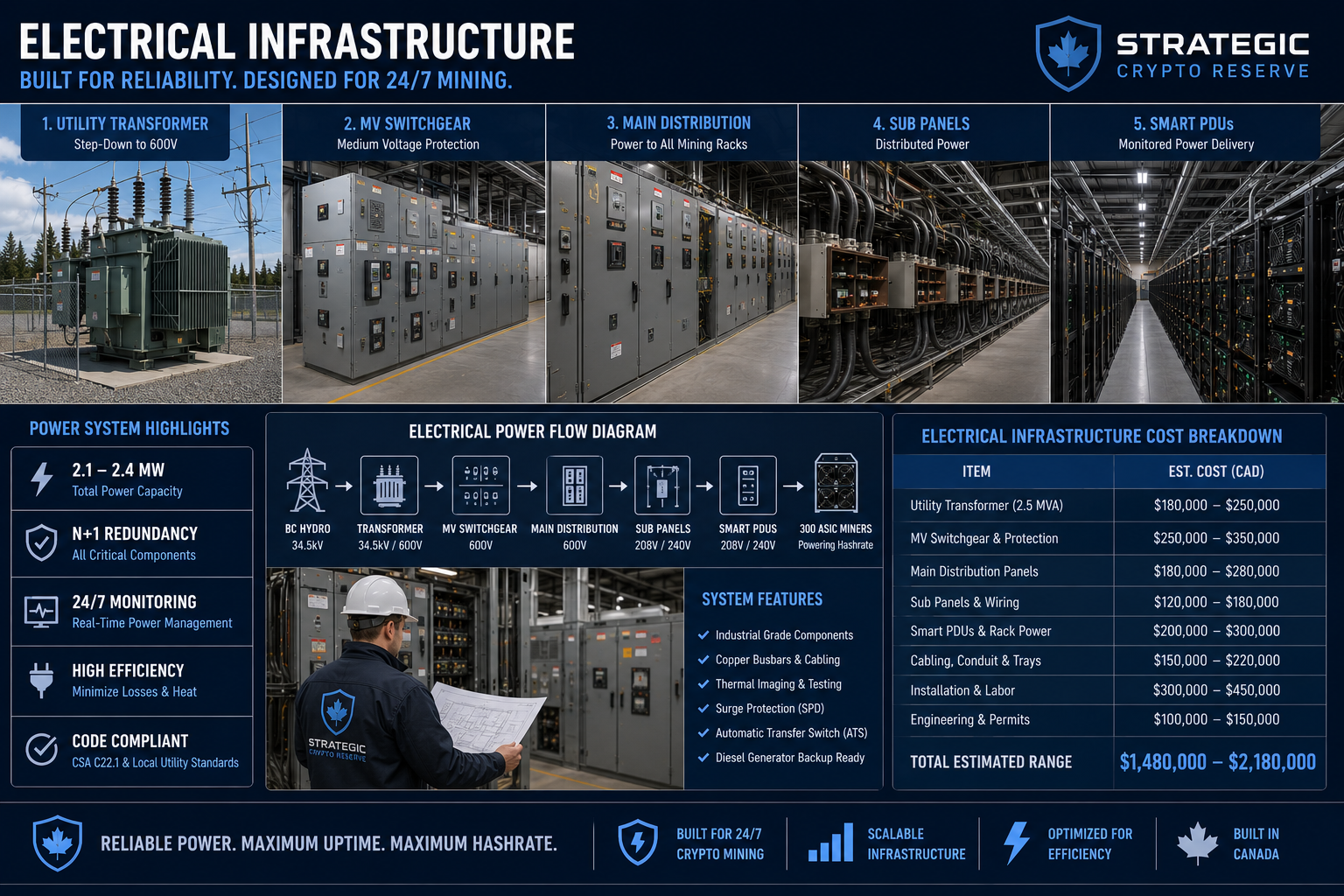
The service entrance is the physical and electrical interface between BC Hydro's distribution grid and your mining facility's internal power infrastructure. It includes the utility transformer, metering equipment, main disconnect, and distribution switchboard that feed every rack position in your operation. Designing this infrastructure correctly — from the moment you engage BC Hydro through to energization day — determines whether your facility is constrained or scalable from the moment it goes live.

The most important design decision in a Vancouver crypto mining service entrance is the transformer capacity. Transformers are sized in kilovolt-amperes (kVA) rather than kilowatts, and the rated kVA must account for your full connected hardware load plus cooling, networking, and facility overhead — not just the mining hardware alone. Undersizing your transformer creates an immediate operational ceiling; oversizing it adds capital cost and may increase your BC Hydro connection fees without delivering operational benefit. The target is a transformer rated for approximately 1.2–1.3× your expected steady-state facility draw, providing headroom for hardware additions and inrush current events without triggering overcurrent protection.

The second major consideration is three-phase power distribution. Commercial ASIC miners and industrial cooling equipment are designed for three-phase 208V or 480V power feeds — not the single-phase residential power found in most standard commercial buildings. Confirm that your facility's service entrance provides balanced three-phase power, and distribute loads symmetrically across all three phases throughout your rack layout. Unbalanced three-phase loads create neutral current that wastes electrical capacity and can trigger power quality issues that affect sensitive control electronics.

Vancouver Advantage — Hydroelectric Grid Stability: One underappreciated benefit of connecting to BC Hydro's Vancouver-area grid is the inherent voltage stability of a predominantly hydroelectric power system. Unlike thermal generation-heavy grids where frequency and voltage fluctuate with generator dispatch changes, BC Hydro's hydro system provides exceptionally stable 60 Hz power with low harmonic distortion. This reduces stress on ASIC miner power supply units and is associated with extended PSU lifespan in operational data from BC-based mining facilities — a tangible but difficult-to-quantify operating cost benefit that compounds over time.

Service entrance engineering for Vancouver crypto mining — transformer sizing, three-phase distribution, and BC Hydro connection process for commercial ASIC mining facilities

Power Factor Correction: The Hidden Billing Lever Most Vancouver Miners Overlook

Power factor correction capacitor bank for Vancouver crypto mining — eliminating BC Hydro reactive demand penalty charges in commercial ASIC mining facilities

Power factor (PF) is a measure of how efficiently your facility converts the electrical power it draws from the BC Hydro grid into useful work performed by your mining hardware. A power factor of 1.0 (or 100%) means every volt-ampere of power you draw from the grid is converted into useful watts by your equipment. A power factor below 1.0 means a portion of the power you draw — called reactive power — performs no useful work but still creates a current flow that BC Hydro's infrastructure must carry.

BC Hydro applies a power factor adjustment charge to commercial accounts where the measured power factor falls below 0.90. This charge applies to the reactive component of your demand and can add 5–12% to your monthly electricity bill when power factor is consistently low. The good news is that power factor problems are fixable — and the fix is permanent once installed.

The standard solution is a capacitor bank installed at your facility's main distribution panel. Capacitor banks supply reactive power locally, eliminating the reactive current demand on BC Hydro's infrastructure and bringing your measured power factor above the 0.90 threshold at which the penalty applies. A correctly sized capacitor bank for a Vancouver crypto mining facility typically costs $8,000–$30,000 CAD installed, depending on facility size and reactive power demand, and pays for itself through eliminated penalty charges within twelve to twenty-four months.

For operators running exclusively current-generation ASIC miners — most of which achieve power factors of 0.95–0.99 natively — power factor penalties may not be a current billing issue. However, facilities with mixed hardware vintages, older PSU units, or significant non-mining loads (large HVAC compressors, older lighting systems) can see facility-level power factor degrade below the BC Hydro threshold. A power quality analyser measurement — a one-time engagement of $300–$800 CAD from a licensed electrician — definitively confirms whether your facility has a power factor problem worth correcting. This measurement should be part of the commissioning checklist for every Vancouver crypto mining facility at startup.

Backup Power and Grid Redundancy for Vancouver Crypto Mining Operations

A Vancouver crypto mining facility operates as a revenue-generating asset every hour it runs. When the grid goes down and that facility goes dark — even briefly — the revenue loss is immediate and unrecoverable. Designing grid redundancy into your facility is not simply a reliability engineering decision; it is a financial decision with a calculable return on investment based on your expected uptime and hourly mining revenue.

The standard approach is a two-tier backup power architecture:

  1. UPS for Management Infrastructure (First Line of Defence): Connect all management infrastructure — network switches, out-of-band server interfaces, smart PDU control systems, monitoring servers, and security cameras — to a UPS rated for ten to fifteen minutes of runtime at full critical load. This tier costs $3,000–$12,000 CAD for a commercial facility and provides two critical functions: clean power ride-through for brief grid events that self-resolve in seconds, and a controlled shutdown window for longer outages that allows you to safely power down ASIC hardware in an ordered sequence rather than experiencing a hard crash. Never connect ASIC mining hardware itself to a UPS — the cost per kW of UPS runtime makes it economically unjustifiable at mining scale.
  2. Generator with Automatic Transfer Switch (ATS) for Extended Outages: A diesel or natural gas generator sized for your critical loads — management infrastructure, lighting, security, and optionally a subset of your most efficient ASIC units — provides extended backup power for outages lasting hours or days. The ATS detects grid failure and automatically transfers the specified loads to generator power within ten to thirty seconds, without requiring manual intervention. Key sizing guidance: your generator should be rated for at minimum 125% of the connected load it will carry in backup mode, and it should be exercised monthly under load to confirm start reliability.
  3. Fuel Storage and Maintenance Contracts: A generator is only as reliable as its fuel supply and maintenance record. For Vancouver-area mining facilities in industrial zones, arrange for diesel fuel storage sufficient for seventy-two hours of full generator operation and establish an annual service contract covering oil changes, coolant checks, air filter replacement, and load bank testing. A generator that fails to start during the one grid outage that matters is worse than no generator — the false sense of security it created is itself a cost.
  4. Dual-Feed Service Entrance for Mission-Critical Facilities: For the largest Vancouver crypto mining operations with significant daily revenue at stake, a dual-feed service entrance — supplied by two independent BC Hydro distribution circuits entering the facility from different directions — provides genuine grid redundancy at the utility level. This requires a more complex service entrance design with an ATS between the two feeds, and BC Hydro approval for the configuration, but eliminates single-circuit distribution failures as a downtime risk. Dual-feed arrangements are standard in tier-3 data centres and are increasingly being adopted by high-revenue mining facilities that cannot tolerate any unplanned downtime.
Backup power and grid redundancy for Vancouver crypto mining — UPS, diesel generator, automatic transfer switch, and dual-feed service entrance design

Power Monitoring Infrastructure: The Tools Vancouver Miners Actually Use

Every power grid strategy in this guide depends on visibility into your facility's real-time power consumption. The following four infrastructure categories form the monitoring foundation of any serious Vancouver crypto mining operation:

Smart PDU Monitoring

Per-outlet wattage and current monitoring at every rack position. Enables zone-level demand visibility, remote power cycling of hung hardware, and automated load shedding triggered by configurable demand thresholds. The highest-return-per-dollar monitoring investment in any mining facility.

Essential — All Scales

Sub-Panel Energy Meters

DIN-rail submeter at each sub-distribution panel provides zone-level kWh consumption tracking and peak demand history by circuit group. Enables precise identification of which hardware cluster or operational zone is driving your BC Hydro demand charge each billing period.

Essential — Commercial Scale

Power Quality Analyser

Measures voltage, current, power factor, harmonic distortion, and frequency at the service entrance. Used for commissioning baseline, power factor correction sizing, and periodic health checks. A one-time engagement confirms whether your facility has billing-impacting power quality issues before BC Hydro's meter does.

Periodic — Annual Check

SCADA / BMS Dashboard

A centralized supervisory control and data acquisition system aggregates readings from all PDUs, submeters, temperature sensors, and generator status into a single real-time dashboard. Enables fully automated demand response, alerts, and daily consumption reports — the operational backbone of a professional Vancouver mining facility.

Advanced — Large Operations

Data Is the Strategy: The most sophisticated power grid strategy is useless without real-time data to act on. Vancouver crypto mining operators who invest in comprehensive power monitoring infrastructure from day one consistently achieve lower demand charge peaks, faster anomaly response times, and better BC Hydro rate optimization outcomes than those who retrofit monitoring after the facility is already running. Budget for monitoring infrastructure as a non-negotiable line item in your facility build — not an optional future upgrade.

Real-World Power Cost Impact: Optimized vs. Unoptimized Vancouver Mining Operations

The following table illustrates the monthly electricity cost difference between a Vancouver crypto mining facility running on a standard commercial rate without optimization, and the same facility with all six power grid strategies implemented. The scenario models a 50-unit mid-range ASIC facility drawing approximately 300 kW of computing load, operated in the Greater Vancouver area on BC Hydro's distribution network.

Billing Component Unoptimized Operation
(Standard Commercial Rate)
Optimized Operation
(Industrial Rate + All 6 Strategies)
Monthly Saving
ENERGY CHARGES (approx. 216,000 kWh/month at 300 kW × 720 hours)
Step 1 energy (first tier, lower rate) ~$2,700 CAD ~$2,200 CAD $500
Step 2 energy (bulk of 24/7 mining consumption) ~$16,200 CAD (high rate) ~$10,500 CAD (industrial rate) $5,700
DEMAND CHARGES
Peak demand charge ($/kW of 15-min peak) ~$6,000 CAD (unmanaged peak at full load) ~$3,800 CAD (demand peak shaving applied) $2,200
PENALTY ADJUSTMENTS
Power factor penalty (applied below PF 0.90) ~$1,400 CAD (mixed hardware, no correction) $0 CAD (capacitor bank installed) $1,400
Basic monthly charge ~$250 CAD ~$250 CAD $0
TOTAL MONTHLY ELECTRICITY COST ~$26,550 CAD ~$16,750 CAD ~$9,800 / month

Illustrative scenario only. Actual BC Hydro billing calculations depend on current approved tariff rates, specific consumption profile, load factor, and applicable rate schedule. All figures in CAD. Verify current rates with BC Hydro commercial services. The $9,800/month saving illustrated above equals $117,600 CAD per year from a 50-unit operation — before accounting for ICI demand response credits, which add further savings for qualifying operators.

Power Grid Strategy in Practice: Lessons from Strategic Crypto Reserve's British Columbia Operations

The power grid strategies described in this guide are not theoretical constructs assembled from textbooks. They reflect the practical, operational experience of running Strategic Crypto Reserve's crypto data center and blockchain infrastructure in British Columbia through real BC Hydro billing cycles, real utility service applications, and real hardware deployment sequences. The specific strategies around phased deployment, smart PDU load management, and demand peak control came directly from measuring what worked and what did not across actual billing periods.

One lesson that cannot be overstated: the power grid application timeline is always the critical path. In our BC operations, the gap between utility service application date and energized switchgear has ranged from four months in optimal conditions to over ten months when transformer procurement delays or infrastructure upgrades were required. The facilities that ran on schedule were the ones where the BC Hydro application was submitted on the first day of planning, before any other commitment was made.

For operators who are still in the foundational planning stages — evaluating space, infrastructure requirements, and the engineering decisions that precede power grid strategy — our complete guide to building a small-scale crypto data center covers the hardware selection, rack layout, cooling design, and network infrastructure decisions that directly interact with your power grid strategy. Power planning and facility design cannot be done in isolation — the decisions are deeply interdependent.

For operators scaling to commercial mining operations where power grid strategy intersects with large-scale facility cost planning, the detailed electricity cost modelling in our monthly operating cost breakdown for a 300-unit mining facility provides the financial framework for quantifying the return on every power optimization investment made at commercial scale.

Strategic Crypto Reserve crypto data center power grid infrastructure in British Columbia — real-world BC Hydro rate optimization and load management for blockchain mining operations

Strategic Crypto Reserve Infrastructure Ecosystem

Crypto Data Center BC

Strategic Crypto Reserve operates blockchain infrastructure and data center facilities in the Comox Valley, British Columbia — supporting NFT drops, blockchain node hosting, and on-chain operations on Polygon and Ethereum.

Vancouver Island Bitcoin Mining

Our Vancouver Island Bitcoin mining operations provide firsthand experience with BC Hydro power infrastructure, ASIC hardware logistics, and real-world power grid strategy implementation — the foundation of the operational guidance in this guide.

Frequently Asked Questions: Power Grid Strategies for Crypto Mining in Vancouver

1. What is the best BC Hydro rate schedule for crypto mining in Vancouver?

The best BC Hydro rate schedule for most commercial crypto mining facilities in Vancouver is Rate Schedule 1200 (General Service — Large), which applies to operations with demand between 35 kW and approximately 1,000 kW. RS 1200 provides access to lower blended per-kWh rates than smaller commercial service classes and includes the demand charge structure that rewards active load management. Operations above 1,000 kW of demand require Transmission Service arrangements with BC Hydro, which involve a separate application and engineering process but typically deliver the lowest blended power costs available to large commercial miners. The critical priority for any Vancouver mining operation is avoiding the standard commercial or small general service rate classes, which carry higher Step 2 energy rates that are specifically disadvantageous for 24/7 high-consumption operations. Confirm your rate schedule eligibility with BC Hydro's commercial services team before signing any facility lease. For context on how rate schedule selection affects total facility operating costs at scale, see our detailed breakdown of Strategic Crypto Reserve's crypto data center infrastructure in British Columbia.

2. How do demand charges work for Vancouver crypto mining operations, and how can I minimize them?

BC Hydro's demand charge on Rate Schedule 1200 is billed per kilowatt of your highest 15-minute average power reading within each billing month. For crypto mining facilities running ASIC hardware continuously, this peak is typically set early in the month and remains essentially fixed for the rest of the billing period. The most effective demand charge reduction strategies for Vancouver crypto mining operations are: phasing hardware deployment in batches rather than powering on all units simultaneously; implementing smart PDU load shedding rules that prevent total facility draw from exceeding a preset demand threshold; participating in BC Hydro's Industrial Conservation Initiative (ICI) demand response program for billing credits in exchange for voluntary curtailment during grid peak periods; and concentrating all planned maintenance reboots into a single billing window to minimize the number of inrush demand spike events per year. Our complete guide to building a small-scale crypto data center covers the smart PDU infrastructure required to make real-time demand management operationally practical.

3. How long does it take to get a large power grid connection in Vancouver for crypto mining?

The timeline for a large commercial power grid connection in the Vancouver area ranges from four to fourteen months from the date of your BC Hydro service application to a fully energized service entrance. Variables affecting the timeline include the complexity of the required transformer and switchgear upgrade, the proximity of your facility to BC Hydro's existing medium-voltage distribution network, the current project queue at BC Hydro's commercial services division, and whether your installation requires an environmental review or municipal permitting process. The single most important implication of this timeline is that your BC Hydro service application must be submitted before any other facility planning commitment is made — before you sign a lease, before you place a hardware order, and before you engage any contractors. Hardware that arrives at a facility before the power connection is energized generates zero mining revenue while incurring full storage costs. The operators who manage Vancouver grid connection timelines most effectively are those who treat the BC Hydro application as the first and highest-priority task in their entire facility development project.

4. Can Vancouver crypto mining operations access renewable energy through BC Hydro?

Yes — and this is one of the most compelling structural advantages that Vancouver and British Columbia crypto mining operations hold over facilities in virtually any other major global mining jurisdiction. BC Hydro's generation portfolio is approximately 98% renewable, sourced primarily from large hydroelectric dams. This means that all power drawn from BC Hydro's grid under standard commercial or industrial service is effectively clean, renewable energy — without paying any green power premium. For operators requiring formal renewable energy certification for ESG compliance, investor reporting, or regulatory purposes, BC Hydro offers green certification programs that provide documented attribution of renewable generation to your facility's consumption. This capability is becoming increasingly valuable as institutional capital, publicly listed mining companies, and regulators apply heightened scrutiny to the environmental footprint of blockchain infrastructure. Vancouver-based crypto mining operations that leverage BC Hydro's renewable grid profile have a credible, documentable sustainability story that operations powered by thermal or coal-based grids fundamentally cannot replicate.

5. What backup power infrastructure do Vancouver crypto mining facilities actually need?

Vancouver crypto mining facilities require a two-tier backup power architecture. The first tier is a UPS (Uninterruptible Power Supply) connected to all management infrastructure — network switches, monitoring servers, smart PDU control systems, and security equipment. A UPS rated for ten to fifteen minutes of runtime at critical load handles brief grid disturbances without hardware disruption and provides a clean shutdown window for longer outages. The second tier is a diesel or natural gas generator connected via an Automatic Transfer Switch (ATS). The ATS detects grid failure and transfers specified loads to generator power within ten to thirty seconds automatically. The generator should be sized for 125% of the connected critical load, exercised monthly under load, and supported by a fuel storage supply sufficient for seventy-two hours of operation. For large Vancouver mining operations processing significant daily revenue, a twelve-hour unplanned outage during a high-Bitcoin-price period can represent a loss that exceeds the entire capital cost of backup power infrastructure. The payback calculation on backup power for commercial-scale mining is straightforward and almost always justifies the investment. For context on how backup power costs factor into total facility operating budgets at scale, review our monthly operating cost breakdown for a 300-unit mining facility.