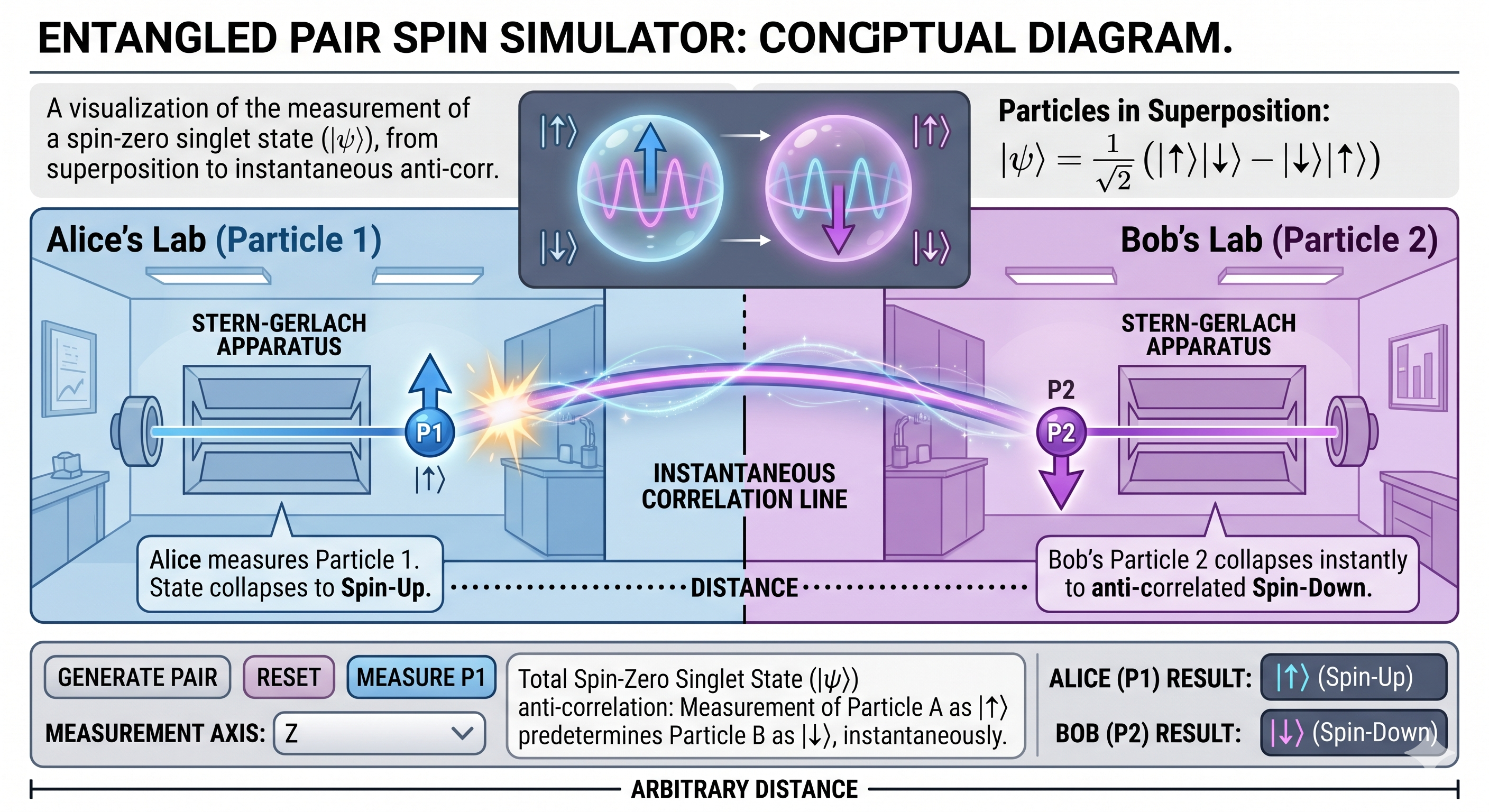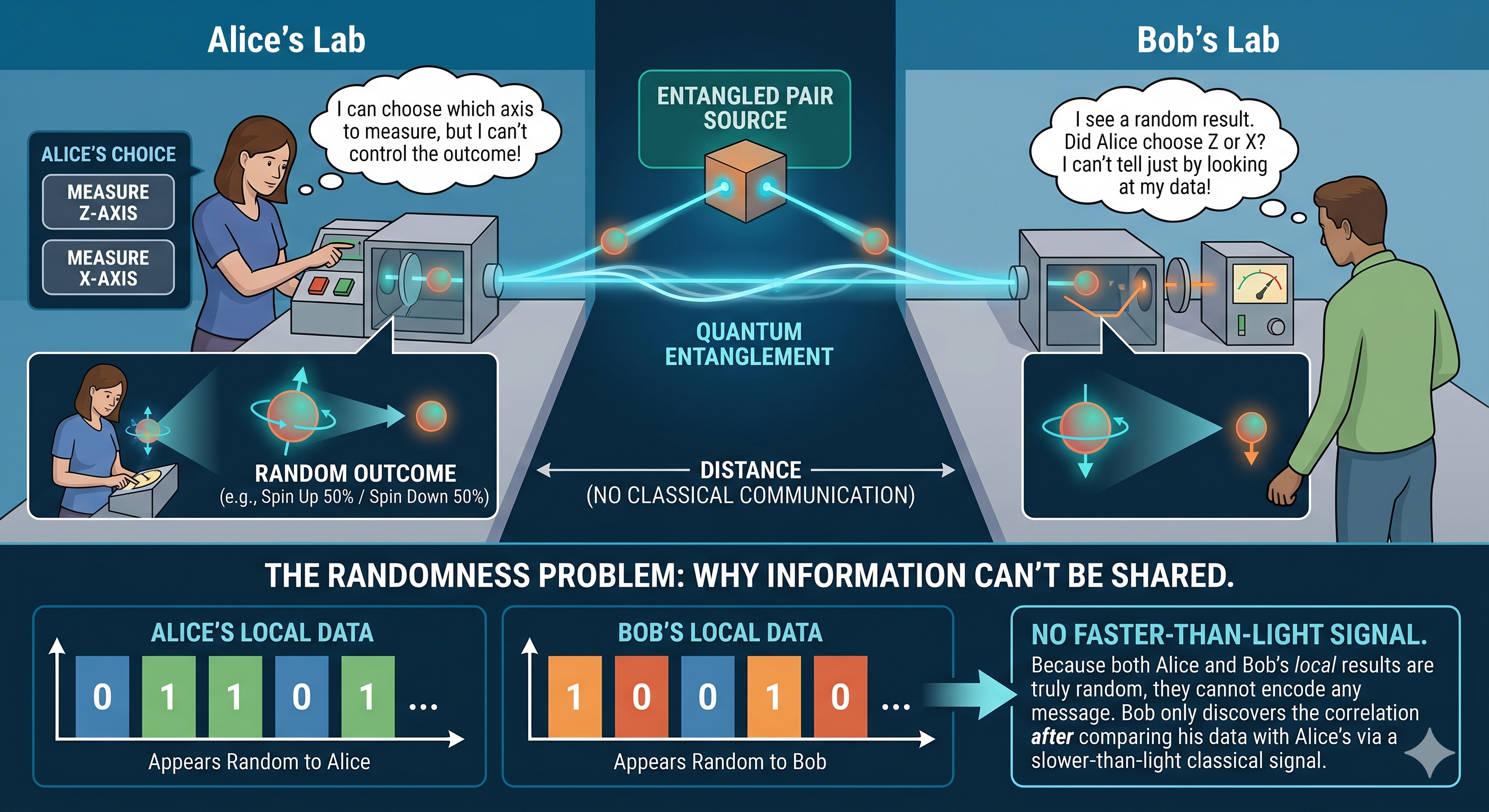
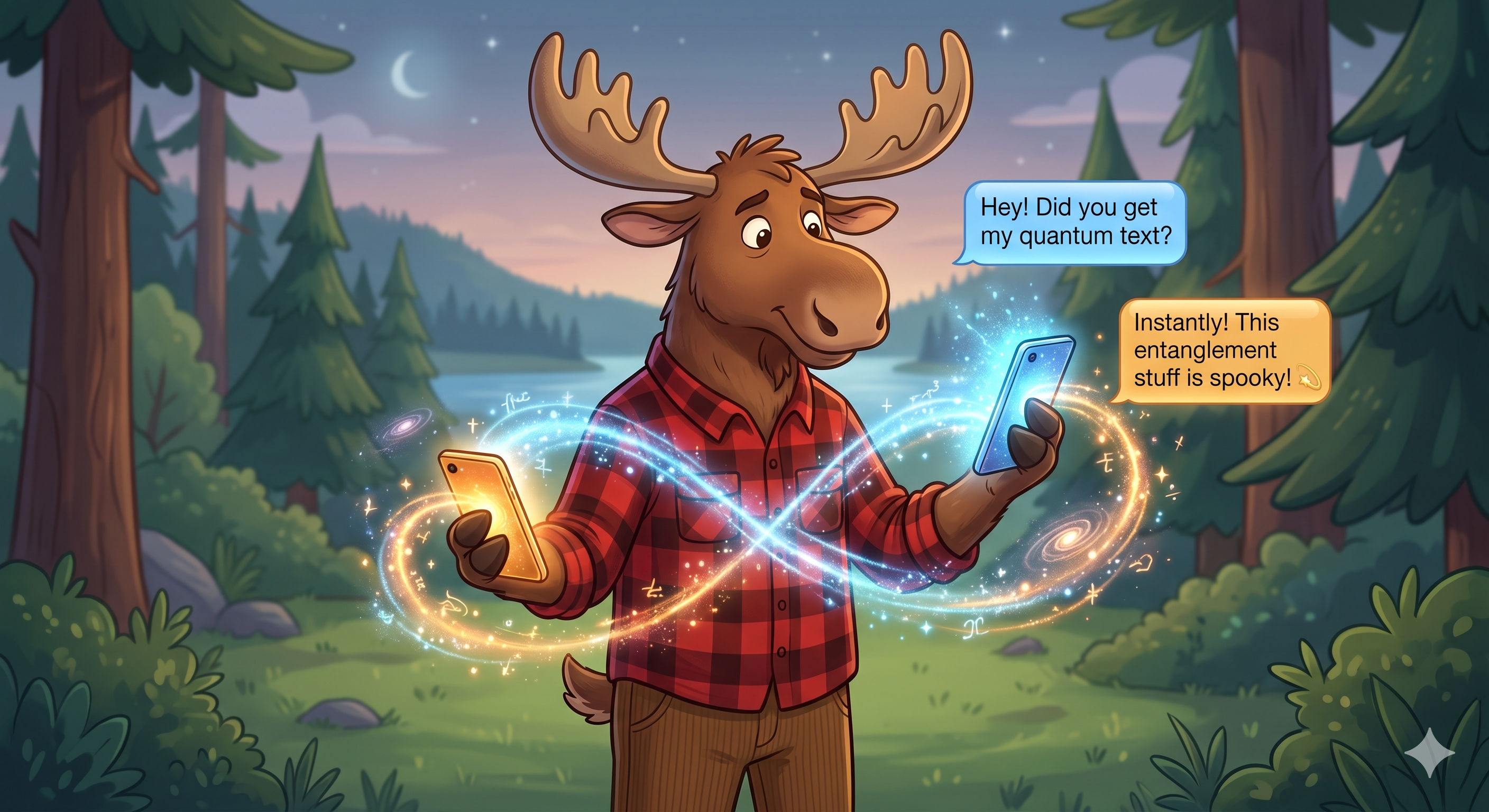
Quantum entanglement is one of the most experimentally verified and genuinely strange phenomena in all of physics. When two particles interact in certain ways, they become entangled — their quantum states are correlated such that measuring one particle instantly determines the state of its partner, regardless of the distance between them. You could place one particle in Vancouver and the other on the far side of the Moon, measure the Vancouver particle, and the Moon particle would instantly snap into a correlated state.
Albert Einstein famously called this "spooky action at a distance" and spent years insisting hidden variables must explain the correlation. In 1964, physicist John Bell devised an elegant mathematical test — Bell's Theorem — that could distinguish genuine quantum entanglement from any hidden variable theory.
Physicist Alain Aspect ran the definitive experiments in 1982, confirming Bell's inequality was violated exactly as quantum mechanics predicts. Hidden variables were ruled out. The spookiness is real. In 2022, Aspect, John Clauser, and Anton Zeilinger received the Nobel Prize in Physics for this body of work. Quantum entanglement is among the most confirmed phenomena in science.
// Bell's Inequality — The Test That Settled It
Bell's inequality sets an upper bound on correlations any local hidden variable theory can produce. Quantum mechanics — and experiment — violates this bound. The implication: entangled particles are correlated in a way that cannot be explained by any pre-existing local properties. The universe is genuinely that strange.